Van de Graaff generator

A Van de Graaff generator is an electrostatic generator which uses a moving belt to accumulate very high amounts of electrical potential on a hollow metal globe on the top of the stand. It was invented by American physicist Robert J. Van de Graaff in 1929. The potential difference achieved in modern Van de Graaff generators can reach 5 megavolts. A tabletop version can produce on the order of 100,000 volts and can store enough energy to produce a visible spark.
A Van de Graaff generator operates by transferring electric charge from a moving belt to a terminal. First invented in 1929, the Van de Graaff generator became a source of high voltage for accelerating subatomic particles to high speeds, making it a useful tool for fundamental physics research.
Description
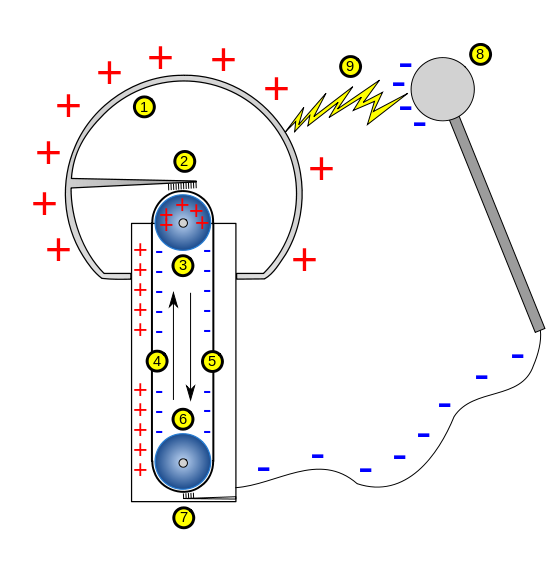
A simple Van de Graaff-generator consists of a belt of silk, or a similar flexible dielectric material, running over two metal pulleys, one of which is surrounded by a hollow metal sphere. Two electrodes,
(2) and (7), in the form of comb-shaped rows of sharp metal points, are
positioned respectively near to the bottom of the lower pulley and
inside the sphere, over the upper pulley. Comb (2) is connected to the
sphere, and comb (7) to the ground. A high DC potential (with respect to
earth) is applied to roller (3); a positive potential in this example.
As the belt passes in front of the lower comb, it receives negative
charge that escapes from its points due to the influence of the electric
field around the lower pulley, which ionizes the air at the points. As
the belt touches the upper roller (6), it transfers some electrons,
leaving the roller with a negative charge (if it is insulated from the
terminal), which added to the negative charge in the belt generates
enough electric field to ionize the air at the points of the upper comb.
Electrons then leak from the belt to the upper comb and to the
terminal, leaving the belt positively charged as it returns down and the
terminal negatively charged. The sphere shields the upper roller and
comb from the electric field generated by charges that accumulate at the
outer surface of it, causing the discharge and change of polarity of
the belt at the upper roller to occur practically as if the terminal
were grounded. As the belt continues to move, a constant charging current
travels via the belt, and the sphere continues to accumulate negative
charge until the rate that charge is being lost (through leakage and corona discharges) equals the charging current. The larger the sphere and the farther it is from ground, the higher will be its final potential.Another method for building Van de Graaff generators is to use the triboelectric effect. The friction between the belt and the rollers, one of them now made of insulating material, or both made with insulating materials at different positions on the triboelectric scale, one above and other below the material of the belt, charges the rollers with opposite polarities. The strong e-field from the rollers then induces a corona discharge at the tips of the pointed comb electrodes. The electrodes then "spray" a charge onto the belt which is opposite in polarity to the charge on the rollers. The remaining operation is otherwise the same as the voltage-injecting version above. This type of generator is easier to build for science fair or homemade projects, since it doesn't require a potentially dangerous high voltage source. The trade-off is that it cannot build up as high a voltage as the other type, that cannot also be easily regulated, and operation may become difficult under humid conditions (which can severely reduce triboelectric effects). Finally, since the position of the rollers can be reversed, the accumulated charge on the hollow metal sphere can either be positive or negative.
A Van de Graaff generator terminal doesn't need to be sphere shaped in order to work, and in fact the optimum shape is a sphere with an inward curve around the hole where the belt enters. Since electrically charged conductors have no e-field inside, charges can be added continuously. A rounded terminal minimizes the electric field around it, allowing greater potentials to be achieved without ionization of the surrounding air, or other dielectric gas. Outside the sphere the e-field quickly becomes very strong and applying charges from the outside would soon be prevented by the field.
Since a Van de Graaff generator can supply the same small current at almost any level of electrical potential, it is an example of a nearly ideal current source. The maximum achievable potential is approximately equal to the sphere's radius multiplied by the e-field where corona discharges begin to form within the surrounding gas. For example, a polished spherical electrode 30 cm in diameter immersed in air at STP (which has a breakdown voltage of about 30 kV/cm) could be expected to develop a maximum voltage of about 450 kV.
History
The Van de Graaff generator was developed, starting in 1929, by physicist Robert J. Van de Graaff at Princeton University with help from colleague Nicholas Burke. The first model was demonstrated in October 1929. The first machine used a silk ribbon bought at a five-and-dime store as the charge transport belt. In 1931 a version able to produce 1,000,000 volts was described in a patent disclosure. This version had two 60 cm diameter charge accumulation spheres mounted on borosilicate glass columns 180 cm high; the apparatus cost only $90 in 1931.
Van de Graaff applied for a patent in December 1931, which was assigned to MIT in exchange for a share of net income. The patent was later granted.
In 1933 Van de Graaff built a 40-foot (12 m) model at MIT's Round Hill facility, the use of which was donated by Colonel Edward H. R. Green.
A more recent development is the tandem Van de Graaff accelerator, containing one or more Van de Graaff generators, in which negatively charged ions are accelerated through one potential difference before being stripped of two or more electrons, inside a high voltage terminal, and accelerated again. An example of a three stage operation has been built in Oxford Nuclear Laboratory in 1964 of a 10 MV single ended "Injector" and a 6 MV EN tandem.
Van de Graaff generators on display