Breaking News

Receive all updates via Facebook. Just Click the Like Button Below...

Showing posts with label high. Show all posts

January 18, 2014

Orbit Downloader

Orbit Downloader


Orbit Downloader is a free Internet download manager that is focusing on improving your overall download experience but also downloading videos, music or files from streaming websites such as YT, MySpace, RapidShare, Pandora and others. Orbit Downloader’s interface was designed to be user friendly but also contains a large number of features to satisfy both beginners and power users.
Orbit Downloader’s features:
  • Organize and manage your downloads with tags.
  • Small application with low system resource usage.
  • Greatly enhanced download speed.
  • Allows you to download social videos, social music and streaming media.
  • Support is enabled for RapidShare download.
  • Download pause and resume options.
  • Support is enabled for HTTP, HTTPS, FTP, MMS, RTSP and RTMP protocols.

Orbit Downloader is licensed as Freeware for the Windows operating system / platform. Orbit Downloader is provided as a free download for all software users (Freeware).


This download is managed by our ad-supported smart download manager. During the download process we may show commercial offers, such as a toolbar or other browser add-ons. The download manager does not have any relationship with the author of this product. The product can be downloaded as well freely from the author's website. You are not obligated to install commercial offer during the process of install
All of the downloads on our website are completely free and are thoroughly reviewed to make sure they are virus free. We use a smart download manager to manage all the downloads initiated from this website.
The download manager is an executable Windows program that enables you to download computer programs, making the download process much faster and showing a progress bar.
The download manager is not installed to the User’s computer, and the User must manually delete the download manager executable.
In addition to managing the download of your selected software, the download manager may show commercial offers. Additional software may include toolbars, browser add-ons, game applications, anti-virus applications, and other types of applications. You are not required to install any additional software to receive your selected software.
If a sponsored software offer, like for example a toolbar, will be offered, it might change the User’s home page, default search settings and 404-error traffic, in the event the User selects such options.
We are NOT distributing modified installers which differ from the originals. All downloads are original and not repacked or modified in any way by us.
The download manager doesn´t have any relationship with the author. The program can be downloaded as well freely from the author's website.

With Orbit Downloader you can comfortably handle all your internet downloads thanks to its perfect integration with popular browsers (Firefox, Opera, Chrome, Internet Explorer), a handy "drop zone" to drag and drop links, an automatic monitoring tool that catches any download links and customized, user-defined filters.
Orbit Downloader features a simple design that makes it easy to use from the very beginning. The program works with most download sites, including those that require a username and password. There's no support for Torrent files though. You can also schedule downloads and make Orbit Downloader scan files with your antivirus right after downloading them.
As for download speed, Orbit Downloader offers a handful of features: multi-thread connections, speed limits (so that your connection is not hogged by the program) and a special P2P-based technology to increase speed.
Orbit Downloader is not just another download manager, but a complete application that includes useful tools to make your downloads faster and easier to manage.
Recent changes
  • Fix: Error downloading from youtube - file size 1.70mb.
  • Improve: You can downloader youtube by getit button and Grab++.
Pros
  • Fast download speed
  • Simple, easy-to-use design
  • Supports P2P and multi-threaded downloads
  • Integrated with most popular web browsers
Cons
  • No support for torrents


Read more ...

August 18, 2013

Van de Graaff generator

Van de Graaff generator


A Van de Graaff generator is an electrostatic generator which uses a moving belt to accumulate very high amounts of electrical potential on a hollow metal globe on the top of the stand. It was invented by American physicist Robert J. Van de Graaff in 1929. The potential difference achieved in modern Van de Graaff generators can reach 5 megavolts. A tabletop version can produce on the order of 100,000 volts and can store enough energy to produce a visible spark.
A Van de Graaff generator operates by transferring electric charge from a moving belt to a terminal. First invented in 1929, the Van de Graaff generator became a source of high voltage for accelerating subatomic particles to high speeds, making it a useful tool for fundamental physics research.


Description

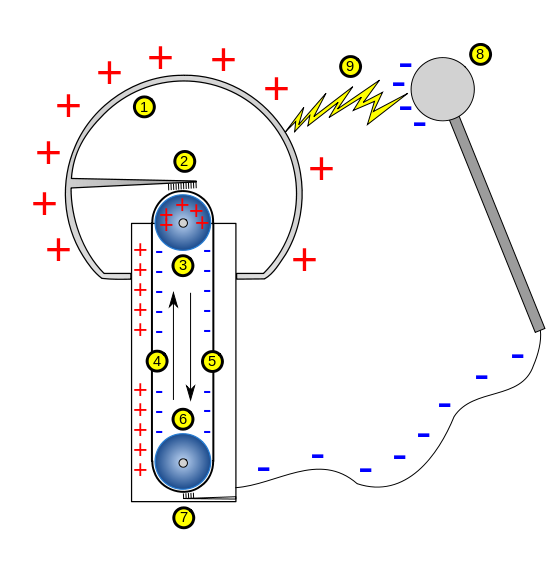
 A simple Van de Graaff-generator consists of a belt of silk, or a similar flexible dielectric material, running over two metal pulleys, one of which is surrounded by a hollow metal sphere. Two electrodes, (2) and (7), in the form of comb-shaped rows of sharp metal points, are positioned respectively near to the bottom of the lower pulley and inside the sphere, over the upper pulley. Comb (2) is connected to the sphere, and comb (7) to the ground. A high DC potential (with respect to earth) is applied to roller (3); a positive potential in this example.
As the belt passes in front of the lower comb, it receives negative charge that escapes from its points due to the influence of the electric field around the lower pulley, which ionizes the air at the points. As the belt touches the upper roller (6), it transfers some electrons, leaving the roller with a negative charge (if it is insulated from the terminal), which added to the negative charge in the belt generates enough electric field to ionize the air at the points of the upper comb. Electrons then leak from the belt to the upper comb and to the terminal, leaving the belt positively charged as it returns down and the terminal negatively charged. The sphere shields the upper roller and comb from the electric field generated by charges that accumulate at the outer surface of it, causing the discharge and change of polarity of the belt at the upper roller to occur practically as if the terminal were grounded. As the belt continues to move, a constant charging current travels via the belt, and the sphere continues to accumulate negative charge until the rate that charge is being lost (through leakage and corona discharges) equals the charging current. The larger the sphere and the farther it is from ground, the higher will be its final potential.

Another method for building Van de Graaff generators is to use the triboelectric effect. The friction between the belt and the rollers, one of them now made of insulating material, or both made with insulating materials at different positions on the triboelectric scale, one above and other below the material of the belt, charges the rollers with opposite polarities. The strong e-field from the rollers then induces a corona discharge at the tips of the pointed comb electrodes. The electrodes then "spray" a charge onto the belt which is opposite in polarity to the charge on the rollers. The remaining operation is otherwise the same as the voltage-injecting version above. This type of generator is easier to build for science fair or homemade projects, since it doesn't require a potentially dangerous high voltage source. The trade-off is that it cannot build up as high a voltage as the other type, that cannot also be easily regulated, and operation may become difficult under humid conditions (which can severely reduce triboelectric effects). Finally, since the position of the rollers can be reversed, the accumulated charge on the hollow metal sphere can either be positive or negative.

A Van de Graaff generator terminal doesn't need to be sphere shaped in order to work, and in fact the optimum shape is a sphere with an inward curve around the hole where the belt enters. Since electrically charged conductors have no e-field inside, charges can be added continuously. A rounded terminal minimizes the electric field around it, allowing greater potentials to be achieved without ionization of the surrounding air, or other dielectric gas. Outside the sphere the e-field quickly becomes very strong and applying charges from the outside would soon be prevented by the field.


Since a Van de Graaff generator can supply the same small current at almost any level of electrical potential, it is an example of a nearly ideal current source. The maximum achievable potential is approximately equal to the sphere's radius multiplied by the e-field where corona discharges begin to form within the surrounding gas. For example, a polished spherical electrode 30 cm in diameter immersed in air at STP (which has a breakdown voltage of about 30 kV/cm) could be expected to develop a maximum voltage of about 450 kV.

History


The fundamental idea for the friction machine as high-voltage supply, using electrostatic influence to charge rotating disk or belt can be traced back to the 17th century or even before (cf. Friction machines History)
The Van de Graaff generator was developed, starting in 1929, by physicist Robert J. Van de Graaff at Princeton University with help from colleague Nicholas Burke. The first model was demonstrated in October 1929. The first machine used a silk ribbon bought at a five-and-dime store as the charge transport belt. In 1931 a version able to produce 1,000,000 volts was described in a patent disclosure. This version had two 60 cm diameter charge accumulation spheres mounted on borosilicate glass columns 180 cm high; the apparatus cost only $90 in 1931.
Van de Graaff applied for a patent in December 1931, which was assigned to MIT in exchange for a share of net income. The patent was later granted.
In 1933 Van de Graaff built a 40-foot (12 m) model at MIT's Round Hill facility, the use of which was donated by Colonel Edward H. R. Green.

A more recent development is the tandem Van de Graaff accelerator, containing one or more Van de Graaff generators, in which negatively charged ions are accelerated through one potential difference before being stripped of two or more electrons, inside a high voltage terminal, and accelerated again. An example of a three stage operation has been built in Oxford Nuclear Laboratory in 1964 of a 10 MV single ended "Injector" and a 6 MV EN tandem.

Van de Graaff generators on display

The largest air-insulated Van de Graaff generator in the world, built by Dr. Van de Graaff in the 1930s, is now on permanent display at Boston's Museum of Science. With two conjoined 4.5 meter (15 foot) aluminium spheres standing on columns 22 feet (6.7 m) tall, this generator can often reach 2 MV (2 million volts). Shows using the Van de Graaff generator and several Tesla coils are conducted two to three times a day. Many science museums, such as the American Museum of Science and Energy, have small-scale Van de Graaff generators on display, and exploit their static-producing qualities to create "lightning" or make people's hair stand up. Van de Graaff generators are also used in schools and in science shows.

Comparison with other high voltage generators

Other classical electrostatic machines like a Wimshurst Machine or a Bonetti machine can easily produce more current than a Van de Graaff generator for experiments with electrostatics, and have positive and negative output. The less-insulated structures, however, result in smaller voltages.
Read more ...

June 27, 2013

2W audio Amplifier

 2W audio Amplifier

Device purpose:

This amplifier was designed to be self-contained in a small loudspeaker box. It can be
feed by Walkman, Mini-Disc, iPod and CD players, computers and similar devices fitted
with line or headphone output. Of course, in most cases you will have to make two boxes to obtain stereo.


Parts:
P1_____________10K Log.Potentiometer
R1,R2__________33K 1/4W Resistors
R3_____________33R 1/4W Resistor
R4_____________15K 1/4W Resistor
R5,R6___________1K 1/4W Resistors
R7____________680R 1/4W Resistor
R8____________120R 1/2W Resistor
R9____________100R 1/2W Trimmer Cermet
C1,C2__________10μF 63V Electrolytic Capacitors
C3____________100μF 25V Electrolytic Capacitor
C4,C7_________470μF 25V Electrolytic Capacitors
C5_____________47pF 63V Ceramic Capacitor
C6____________220nF 63V Polyester Capacitor
C8___________1000μF 25V Electrolytic Capacitor
D1___________1N4148 75V 150mA Diode
Q1____________BC560C 45V 100mA PNP Low noise High gain Transistor
Q2____________BC337 45V 800mA NPN Transistor
Q3____________TIP31A 60V 4A NPN Transistor
Q4 ___________TIP32A 60V 4A PNP Transistor
SW1___________SPST switch

SPKR__________3-5 Watt Loudspeaker, 8, 4 or 2 Ohm impedance


The circuit was deliberately designed using no ICs and in a rather old-fashioned manner in
order to obtain good harmonic distortion behavior and to avoid hard to find components.
The amplifier(s) can be conveniently supplied by a 12V wall plug-in adapter.
Closing SW1 a bass-boost is provided but, at the same time, volume control must be increased to compensate for power loss at higher frequencies.
In use, R9 should be carefully adjusted to provide minimal audible signal cross-over
distortion consistent with minimal measured quiescent current consumption; a good
compromise is to set the quiescent current at about 10-15 mA.
To measure this current, wire a DC current meter temporarily in series with the collector
of Q3.

Technical data:

Output power:

1.5 Watt RMS into 8 Ohm, 2.5 Watt into 4 Ohm, 3.5 Watt into 2 Ohm (1KHz
sinewave)

Sensitivity:

100mV input for 1.5W output @ 8 Ohm

Frequency response:

30Hz to 20KHz -1dB

Total harmonic distortion @ 1KHz & 10KHz:

<0.2% @ 8 Ohm 1W, <0.3% @ 4 Ohm 2W, <0.5% @ 2 Ohm 2W
Read more ...
Designed By Published.. Blogger Templates