Breaking News

Receive all updates via Facebook. Just Click the Like Button Below...

Showing posts with label 16. Show all posts

January 4, 2015

Microcontroller - Introduction

Microcontroller

Microcontroller can be termed as a single on chip computer which includes number of peripherals like RAM, EEPROM, Timers etc., required to perform some predefined task.


There are number of popular families of microcontrollers which are used in different applications as per their capability and feasibility to perform the desired task, most common of these are 8051, AVR and PIC microcontrollers.

         
With microcontrollers in general, it is good to know that these little chips are found everywhere. You can find them in microwaves ovens, new applicances, automobiles, televisions, etc. These microcontrollers control and sense the surrounding electronics and environment. For example, microcontrollers can provide output to a display, motor, LEDS, etc., sensing the environment, such as tilt using an accellerometer, light, angular velocity using a MEMS (Microelectromechanical System) gyroscope, sound, encoders for movement, temperature, and button or keyboard input.


To give you a basic understanding of the microcontroller, the AVR Atmega32 microcontroller is considered to be a computer on a chip. The microcontroller is able to execute a set of instructions in the form of a program. The program language that I will be using for theseprojects is C++. To giv ethe usersof this website the best opportunity to learn, the C++ programs will be explained is great detail.

AVR

AVR was developed in the year 1996 by Atmel Corporation. The architecture of AVR was developed by Alf-Egil Bogen and Vegard Wollan. AVR derives its name from its developers and stands for Alf-Egil Bogen Vegard Wollan RISC microcontroller, also known as Advanced Virtual RISC. The AT90S8515 was the first microcontroller which was based on AVR architecture however the first microcontroller to hit the commercial market was AT90S1200 in the year 1997.
AVR microcontrollers are available in three categories:


1.      TinyAVR – Less memory, small size, suitable only for simpler applications


2.      MegaAVR – These are the most popular ones having good amount of memory (upto 256 KB),               higher number of inbuilt peripherals and suitable for moderate to complex applications.

3.      XmegaAVR – Used commercially for complex applications, which require large program memory         and high speed.
The following table compares the above mentioned AVR series of microcontrollers:
 
Series Name
Pins
Flash Memory
Special Feature
TinyAVR
6-32
0.5-8 KB
Small in size
MegaAVR
28-100
4-256KB
Extended peripherals
XmegaAVR
44-100
16-384KB
DMA, Event System included
What’s special about AVR?
They are fast: AVR microcontroller executes most of the instructions in single execution cycle. AVRs are about 4 times faster than PICs, they consume less power and can be operated in different power saving modes. Let’s do the comparison between the three most commonly used families of microcontrollers.
8051
PIC
AVR
SPEED
Slow
Moderate
Fast
MEMORY
Small
Large
Large
ARCHITECTURE
CISC
RISC
RISC
ADC
Not Present
Inbuilt
Inbuilt
Timers
Inbuilt
Inbuilt
Inbuilt
PWM Channels
Not Present
Inbuilt
Inbuilt
Read more ...

November 27, 2014

16x2 LCD Module

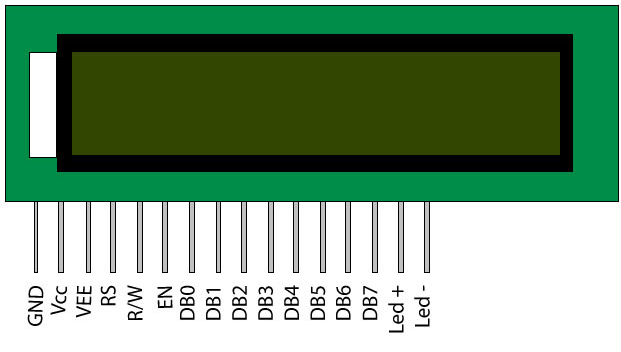
16x2 LCD

A 16x2 LCD means it can display 16 characters per line and there are 2 such lines. In this LCD each character is displayed in 5x7 pixel matrix. This LCD has two registers, namely, Command and Data.


LCD (Liquid Crystal Display) screen is an electronic display module and find a wide range of applications. A 16x2 LCD display is very basic module and is very commonly used in various devices and circuits. These modules are preferred over seven segments and other multi segment LEDs. The reasons being: LCDs are economical; easily programmable; have no limitation of displaying special & even custom characters (unlike in seven segments), animations and so on.

The command register stores the command instructions given to the LCD. A command is an instruction given to LCD to do a predefined task like initializing it, clearing its screen, setting the cursor position, controlling display etc. The data register stores the data to be displayed on the LCD. The data is the ASCII value of the character to be displayed on the LCD. Click to learn more about internal structure of a LCD.
 
Pin Diagram: 


 Pin No
 Function
 Name
1
Ground (0V)
Ground
2
Supply voltage; 5V (4.7V – 5.3V)
 Vcc
3
Contrast adjustment; through a variable resistor
 VEE
4
Selects command register when low; and data register when high
Register Select
5
Low to write to the register; High to read from the register
Read/write
6
Sends data to data pins when a high to low pulse is given
Enable
7
8-bit data pins
DB0
8
DB1
9
DB2
10
DB3
11
DB4
12
DB5
13
DB6
14
DB7
15
Backlight VCC (5V)
Led+
16
Backlight Ground (0V)
Led-

The LCD works with voltage pulses only and that with precise timing and voltage levels. Hence special kinds of LCD drivers are developed to drive the LCD. Two or more of this kind of driver ICs together with the LCD screen forms LCD modules which are normally found in embedded systems.The LCD module makes a system stand-alone which can take input and display the corresponding output.
Read more ...
Designed By Published.. Blogger Templates