Breaking News

Receive all updates via Facebook. Just Click the Like Button Below...

Showing posts with label use. Show all posts

November 27, 2014

16x2 LCD Module

16x2 LCD

16x2 LCD means it can display 16 characters per line and there are 2 such lines. In this LCD each character is displayed in 5x7 pixel matrix. This LCD has two registers, namely, Command and Data.


LCD (Liquid Crystal Display) screen is an electronic display module and find a wide range of applications. A 16x2 LCD display is very basic module and is very commonly used in various devices and circuits. These modules are preferred over seven segments and other multi segment LEDs. The reasons being: LCDs are economical; easily programmable; have no limitation of displaying special & even custom characters (unlike in seven segments), animations and so on.

The command register stores the command instructions given to the LCD. A command is an instruction given to LCD to do a predefined task like initializing it, clearing its screen, setting the cursor position, controlling display etc. The data register stores the data to be displayed on the LCD. The data is the ASCII value of the character to be displayed on the LCD. Click to learn more about internal structure of a LCD.
 
Pin Diagram: 
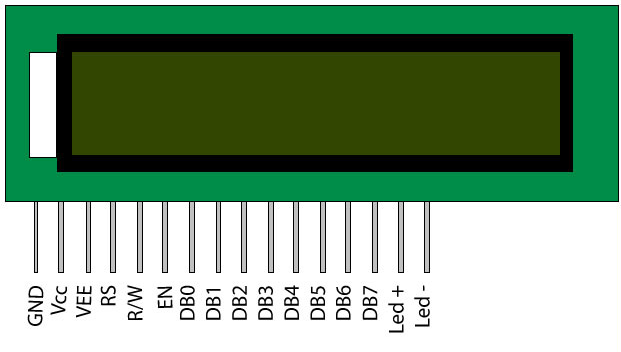

 Pin No
 Function
 Name
1
Ground (0V)
Ground
2
Supply voltage; 5V (4.7V – 5.3V)
 Vcc
3
Contrast adjustment; through a variable resistor
 VEE
4
Selects command register when low; and data register when high
Register Select
5
Low to write to the register; High to read from the register
Read/write
6
Sends data to data pins when a high to low pulse is given
Enable
7
8-bit data pins
DB0
8
DB1
9
DB2
10
DB3
11
DB4
12
DB5
13
DB6
14
DB7
15
Backlight VCC (5V)
Led+
16
Backlight Ground (0V)
Led-

The LCD works with voltage pulses only and that with precise timing and voltage levels. Hence special kinds of LCD drivers are developed to drive the LCD. Two or more of this kind of driver ICs together with the LCD screen forms LCD modules which are normally found in embedded systems.The LCD module makes a system stand-alone which can take input and display the corresponding output.
Read more ...

August 10, 2014

What fevikwik made of?

What fevikwik made of?

Cyanoacrylate

Cyanoacrylate is the generic name for a family of strong fast-acting adhesives with industrial, medical and household uses. Cyanoacrylate adhesives have a short shelf life if not used, about one year from manufacture if unopened, one month once opened. They have some minor toxicity.

Cyanoacrylates include methyl 2-cyanoacrylate, ethyl-2-cyanoacrylate (commonly sold under trade names such as "Super Glue", "fevikwik" and "Krazy Glue"), n-butyl cyanoacrylate and 2-octyl cyanoacrylate (used in medical, veterinary and first aid applications). Octyl cyanoacrylate was developed to address toxicity concerns and to reduce skin irritation and allergic response. Cyanoacrylate adhesives are sometimes known generically as instant glues or superglues (although "Super Glue" is a trade name). The abbreviation "CA" is commonly used for industrial grades.


Development

The original cyanoacrylates (the chemical name for the glue) were discovered in 1942 in a search for materials to make clear plastic gun sights during World War II, when a team of scientists headed by Harry Wesley Coover Jr. stumbled upon a formulation that stuck to everything that it came in contact with; it was rejected for the application. In 1951 cyanoacrylates were rediscovered by Eastman Kodak researchers Harry Coover and Fred Joyner, who recognized their true commercial potential; "Eastman #910" (later "Eastman 910") was the first cyanoacrylate adhesive to be sold, in 1958.

During the 1960s Eastman Kodak sold cyanoacrylate to Loctite, which in turn repackaged and distributed it under a different brand name "Loctite Quick Set 404". In 1971 Loctite developed its own manufacturing technology and introduced its own line of cyanoacrylate, called "Super Bonder". Loctite quickly gained market share, and by the late 1970s it was believed to have exceeded Eastman Kodak's share in the North American industrial cyanoacrylate market. National Starch and Chemical Company purchased Eastman Kodak’s cyanoacrylate business and combined it with several acquisitions made throughout the 1970s forming Permabond. Other manufacturers of cyanoacrylate include LePage (a Canadian company acquired by Henkel in 1996), the Permabond Division of National Starch and Chemical, Inc., which was a subsidiary of Unilever. Together, Loctite, Eastman and Permabond accounted for approximately 75% of the industrial cyanoacrylate market. As of 2013 Permabond continued to manufacture the original 910 formula.

Properties

In its liquid form, cyanoacrylate consists of monomers of cyanoacrylate molecules. Methyl-2-cyanoacrylate (CH2=C(CN)COOCH3 or C5H5NO2) has a molecular weight equal to 111.1, a flashpoint of 79 °C, and a density of 1.1 g/ml. Ethyl 2-cyanoacrylate (C6H7NO2) has a molecular weight equal to 125 and a flashpoint of >75 °C. To facilitate easy handling, a cyanoacrylate adhesive is frequently formulated with an ingredient such as fumed silica to make it more viscous or gel-like. More recently, formulations are available with additives to increase shear strength, creating a more impact resistant bond. Such additives may include rubber, as in Loctite's Ultra Gel, or others which are not specified.

In general, cyanoacrylate is an acrylic resin that rapidly polymerises in the presence of water (specifically hydroxide ions), forming long, strong chains, joining the bonded surfaces together. Because the presence of moisture causes the glue to set, exposure to normal levels of humidity in the air causes a thin skin to start to form within seconds, which very greatly slows the reaction. Because of this cyanoacrylate is applied thinly, to ensure that the reaction proceeds rapidly and a strong bond is formed within a reasonable time.


The reaction with moisture can cause a container of glue which has been opened and resealed to become unusable more quickly than if never opened. To minimise this reduction in shelf life cyanoacrylate, once opened, can be stored in an airtight container with a package of silica gel desiccant. Another technique is to insert a hypodermic needle into the opening of a tube. After using the glue, residual glue soon clogs the needle, keeping moisture out. The clog is removed by heating the needle (e.g., by a lighter) before use.


Uses

Cyanoacrylates are mainly used as adhesives. They require some care and knowledge for effective use: they do not bond some materials; their shelf life at room temperature is about 12 months unopened and one month once opened; they do not fill spaces, unlike epoxies, and a very thin layer bonds more effectively than a thicker one that does not cure properly; they bond many substances, including human skin and tissues, almost instantly and can cause harm to people.

Cyanoacrylate glue has a low shearing strength, which has led to its use as a temporary adhesive in cases where the piece needs to be sheared off later. Common examples include mounting a workpiece to a sacrificial glue block on a lathe, and tightening pins and bolts.

Cyanoacrylates are used to assemble prototype electronics (see wire wrap), flying model aircraft, and as retention dressings for nuts and bolts. Their effectiveness in bonding metal and general versatility have made them popular among modeling and miniatures hobbyists. They are used to re-harden the boxes and shanks of ballerinas' pointe shoes.

Cyanoacrylate glue's ability to resist water has made it popular with marine aquarium hobbyists for fragging corals. The cut branches of hard corals such as Acropora can be glued to a piece of live rock (harvested reef coral) or Milliput (epoxy putty) to allow the new frag to grow out. It is actually safe to use directly in the tank, unlike silicone, which must be cured to be safe. However, as a class of adhesives, traditional cyanoacrylates are classified as having "weak" resistance to both moisture and heat although the inclusion of phthalic anhydride reportedly counteracts both of these characteristics.


Most standard cyanoacrylate adhesives do not bond well with smooth glass, although they can be used as a quick, temporary bond prior to application of an epoxy or cyanoacrylate specifically formulated for use on glass. A mechanical adhesive bond may be formed around glass fibre mat or tissue to reinforce joints or to fabricate small parts.

Cyanoacrylate is used in the cosmetology/beauty industry as a "nail glue" for some artificial nail enhancements such as nail tips and nail wraps, and is sometimes mistaken for eye drops causing accidental injury.

Safety issues

Toxicity

The fumes from CA are a vaporized form of the cyanoacrylate monomer that irritate sensitive membranes in the eyes, nose, and throat. They are immediately polymerized by the moisture in the membranes and become inert. These risks can be minimized by using CA in well ventilated areas. About 5% of the population can become sensitized to CA fumes after repeated exposure, resulting in flu-like symptoms. It may also act as a skin irritant and may cause an allergic skin reaction. The ACGIH assign a Threshold Limit Value exposure limit of 200 parts per billion. On rare occasions, inhalation may trigger asthma. There is no singular measurement of toxicity for all cyanoacrylate adhesives as there is a wide variety of adhesives that contain various cyanoacrylate formulations.

The United States National Toxicology Program and the United Kingdom Health and Safety Executive have concluded that the use of ethyl cyanoacrylate is safe and that additional study is unnecessary. 2-octyl cyanoacrylate degrades much more slowly due to its longer organic backbone that slows the degradation of the adhesive enough to remain below the threshold of tissue toxicity. Due to the toxicity issues of ethyl cyanoacrylate, the use of 2-octyl cyanoacrylate for sutures is preferred.

Reaction with cotton


Applying cyanoacrylate to some materials made of cotton or wool (such as cotton swabs, cotton balls, and certain yarns or fabrics) results in a powerful, rapid exothermic reaction. The heat released may cause serious burns, ignite the cotton product, or release irritating white smoke. Material Safety Data Sheets for cyanoacrylate instruct users not to wear cotton or wool clothing, especially cotton gloves, when applying or handling cyanoacrylates.

Solvents and debonders

Acetone, commonly found in nail polish remover, is a widely available solvent capable of softening cured cyanoacrylate. Other solvents include nitromethane, dimethyl sulfoxide, and methylene chloride. gamma-Butyrolactone may also be used to remove cured cyanoacrylate. Commercial debonders are also available.

Shelf life

Cyanoacrylate adhesives have a short shelf life. Date-stamped containers help to ensure that the adhesive is still viable. One manufacturer supplies the following information and advice: when kept unopened in a cool, dry location such as a refrigerator at a temperature of about 55°F (13°C), the shelf life of cyanoacrylate will be extended from about one year from manufacture to at least 15 months. If the adhesive is to be used within six months, it is not necessary to refrigerate it. Cyanoacrylates are moisture-sensitive, and moving from a cool to a hot location will create condensation; after removing from the refrigerator, it is best to let the adhesive reach room temperature before opening. After opening cyanoacrylate should be used within thirty days. Open containers should not be refrigerated. Another manufacturer says that the maximum shelf life of 12 months is obtained for some of their cyanoacrylates if the original containers are stored at 35 to 40 °F (2 to 4 °C). User forums and some manufacturers say that an almost unlimited shelf life is attainable by storing unopened at −20 °C (−4 °F), the typical temperature of a domestic freezer, and allowing to reach room temperature before use. (Rechilling an opened container is not advisable as it will cause moisture from the air to condense in the container, causing deterioration.)


As cyanoacrylates age they polymerize, become thicker, and cure more slowly. They can be thinned with a cyanoacrylate of the same chemical composition with lower viscosity.
Read more ...

June 17, 2014

Cell Phone Controlled Home appliances

Cell Phone Controlled Home appliances

Many of us face problem when we out of our home like if we want to on the motor, so that when we reach home water will be filled in over head tank or we want to on other appliances like light fan etc.
Hence to solve this problem we have describe a simple circuit which will on your device or appliances remotely and it will become off automatically after preset time interval.
Many circuits have been developed so far to solve this problem but main advantage of this circuit is uses readily available components and this circuit is not expensive as well because this circuit is made using without microcontroller.

This circuit is based on two IC's namely MT8870 which is DTMF decoder IC and another is NE555 timer which is wired as monostable multivibrator with few more components like crystal, relay, resistors and capacitors.

How to operate a device remotely
In this circuit for operating a device we will require two cell phone, one will be with us from which we will call on the other cell phone which is connected to device. And other cell phone will be connected to the device in auto answer mode. For operating the device call on the cell phone which is connected to the device as this cell phone is in auto answer mode it will pick up the call automatically . When ring stop dial number 7 from the keypad of the mobile from which you are calling. Now the device connected to it with the relay start operating and will become off automatically after certain time period.

Working of circuit

Connect the cell phone  with the head phone or ear phone properly at mobile phone audio jack.  Now when you call on the mobile connected with device at the receiving end DTMF decoder IC will provide a high pulse at pin 15 after detecting the valid tone pair. This will trigger the pin 2 of IC2 and its output will go from high to low. This in turn make the output pin 3 of IC2 high and the transistor T2 connected to it start conducting because of this relay energise and device become on. The time period for which device remain on can be adjusted with the help of variable resistor VR1 and capacitor C4. By increasing or decreasing the value of variable resistor and capacitor  time period can be increased or decreased. This can be calculated by the below formula-
Time period = 1.1*VR1*C4 in seconds
In this circuit transistor T1 will only conduct when all the outputs pin 11, pin12, pin13 and pin15 will become high simultaneously with the help of diode D1 to D5. This can only be done by pressing the number 7 through DTMF decoder. The DTMF signal send from the dialler mobile end is decoded by the DTMF decoder and its respective BCD value appear at the output on pin 11, pin12, pin13. That's  why to on the device we are using number 7.


Read more ...

February 19, 2014

Blu-ray Disc

Blu-ray Disc


Blu-ray Disc (BD) is a digital optical disc data storage format designed to supersede the DVD format. The plastic disc is 120 mm in diameter and 1.2 mm thick, the same size as DVDs and CDs. Conventional (pre-BD-XL) Blu-ray Discs contain 25 GB per layer, with dual layer discs (50 GB) being the industry standard for feature-length video discs. Triple layer discs (100 GB) and quadruple layers (128 GB) are available for BD-XL re-writer drives. The name Blu-ray Disc refers to the blue laser used to read the disc, which allows information to be stored at a greater density than is possible with the longer-wavelength red laser used for DVDs.

 The major application of Blu-ray Discs is as a medium for video material such as feature films. Besides the hardware specifications, Blu-ray Disc is associated with a set of multimedia formats. Generally, these formats allow for the video and audio to be stored with greater definition than on DVD.

The format was developed by the Blu-ray Disc Association, a group representing makers of consumer electronics, computer hardware, and motion pictures. Sony unveiled the first Blu-ray Disc prototypes in October 2000, and the first prototype player was released in April 2003 in Japan. Afterwards, it continued to be developed until its official release in June 2006. As of June 2008, more than 2,500 Blu-ray Disc titles were available in Australia and the United Kingdom, with 3,500 in the United States and Canada. In Japan, as of July 2010, more than 3,300 titles have been released.

During the high definition optical disc format war, Blu-ray Disc competed with the HD DVD format. Toshiba, the main company that supported HD DVD, conceded in February 2008, releasing its own Blu-ray Disc player in late 2009.


Media type High-density optical disc
Encoding
H.262/MPEG-2 Part 2
H.264/MPEG-4 AVC
VC-1
Capacity
25 GB (single-layer)
50 GB (dual-layer)
100/128 GB (BDXL)
Block size 64 KB ECC
Read mechanism 405 nm diode laser
Developed by Blu-ray Disc Association
Dimensions
120 mm (4.7 in) diameter
1.2 mm thickness
Usage

Data storage
High-definition video (1080p) High-definition audio
Stereoscopic 3D
PlayStation 3 games
PlayStation 4 games
Xbox One games


History

The information density of the DVD format was limited by the wavelength of the laser diodes used. Following protracted development, blue laser diodes operating at 405 nanometers became available on a production basis. Sony started two projects in collaboration with Philips applying the new diodes: UDO (Ultra Density Optical), and DVR Blue (together with Pioneer), a format of rewritable discs that would eventually become Blu-ray Disc (more specifically, BD-RE). The core technologies of the formats are similar.

The first DVR Blue prototypes were unveiled at the CEATEC exhibition in October 2000 by Sony. A trademark for the "Blue Disc" logo was filed February 9, 2001. On February 19, 2002, the project was officially announced as Blu-ray Disc, and Blu-ray Disc Founders was founded by the nine initial members.
The first consumer device arrived in stores on April 10, 2003: the Sony BDZ-S77, a $3,800 (US) BD-RE recorder that was made available only in Japan. But there was no standard for prerecorded video, and no movies were released for this player.

Hollywood studios insisted that players be equipped with digital rights management before they would release movies for the new format, and they wanted a new DRM system that would be more secure than the failed Content Scramble System (CSS) used on DVDs.

On October 4, 2004, the name "Blu-ray Disc Founders" was officially changed to the Blu-ray Disc Association (BDA), and 20th Century Fox joined the BDA's Board of Directors.
The Blu-ray Disc physical specifications were completed in 2004.

AACS LA, a consortium founded in 2004, had been developing the DRM platform that could be used to securely distribute movies to consumers. However, the final AACS standard was delayed,[23] and then delayed again when an important member of the Blu-ray Disc group voiced concerns. At the request of the initial hardware manufacturers, including Toshiba, Pioneer, and Samsung, an interim standard was published that did not include some features, such as managed copy.


Competition from HD DVD


The DVD Forum, chaired by Toshiba, was split over whether to develop the more expensive blue laser technology. In March 2002, the forum approved a proposal endorsed by Warner Bros. and other motion picture studios that involved compressing HD content onto dual-layer standard DVD-9 discs. In spite of this decision, however, the DVD Forum's Steering Committee announced in April that it was pursuing its own blue-laser high-definition video solution. In August, Toshiba and NEC announced their competing standard, Advanced Optical Disc. It was finally adopted by the DVD Forum and renamed HD DVD the next year,after being voted down twice by DVD Forum members who were also Blu-ray Disc Association members—a situation that drew preliminary investigations by the U.S. Department of Justice.

HD DVD had a head start in the high-definition video market, as Blu-ray Disc sales were slow to gain market share. The first Blu-ray Disc player was perceived as expensive and buggy, and there were few titles available.
The appearance of the Sony PlayStation 3, which contained a Blu-ray Disc player for primary storage, helped support Blu-ray. Sony also ran a more thorough and influential marketing campaign for the format. 2006 also saw the launch of AVCHD camcorders, whose recordings can be played back on many Blu-ray Disc players without re-encoding, but not on HD DVD players.

By January 2007, Blu-ray Discs had outsold HD DVDs, and during the first three-quarters of 2007, BD outsold HD DVD by about two to one. At CES 2007, Warner proposed Total Hi Def—a hybrid disc containing Blu-ray on one side and HD DVD on the other, but it was never released.

Physical media


Laser and optics

While a DVD uses a 650 nm red laser, Blu-ray Disc uses a 405 nm "blue" laser diode. Note that even though the laser is called "blue", its color is actually in the violet range. The shorter wavelength can be focused to a smaller area, thus enabling it to read information recorded in pits that are less than half the size of those on a DVD, and can consequently be spaced more closely, resulting in a shorter track pitch, enabling a Blu-ray Disc to hold about five times the amount of information that can be stored on a DVD.
The lasers are GaN (gallium nitride) laser diodes that produce 405 nm light directly, that is, without frequency doubling or other nonlinear optical mechanisms. Conventional DVDs use 650 nm red lasers, and CDs use 780 nm near-infrared lasers.


The minimum "spot size" on which a laser can be focused is limited by diffraction, and depends on the wavelength of the light and the numerical aperture of the lens used to focus it. By decreasing the wavelength, increasing the numerical aperture from 0.60 to 0.85, and making the cover layer thinner to avoid unwanted optical effects, the laser beam can be focused to a smaller spot, which effectively allows more information to be stored in the same area. For Blu-ray Disc, the spot size is 580 nm. This allows a reduction of the pit size from 400 nm for DVD to 150 nm for Blu-ray Disc, and of the track pitch from 740 nm to 320 nm. See Compact Disc for information on optical discs' physical structure.

In addition to the optical improvements, Blu-ray Discs feature improvements in data encoding that further increase the amount of content that can be stored.

Hard-coating technology

Since the Blu-ray Disc data layer is closer to the surface of the disc compared to the DVD standard, it was at first more vulnerable to scratches. The first discs were housed in cartridges for protection, resembling Professional Discs introduced by Sony in 2003.

Using a cartridge would increase the price of an already expensive medium, so hard-coating of the pickup surface was chosen instead. TDK was the first company to develop a working scratch-protection coating for Blu-ray Discs. It was named Durabis. In addition, both Sony and Panasonic's replication methods include proprietary hard-coat technologies. Sony's rewritable media are spin-coated, using a scratch-resistant and antistatic coating. Verbatim's recordable and rewritable Blu-ray Discs use their own proprietary technology, called Hard Coat.
The Blu-ray Disc specification requires the testing of resistance to scratches by mechanical abrasion. In contrast, DVD media are not required to be scratch-resistant, but since development of the technology, some companies, such as Verbatim, implemented hard-coating for more expensive lineups of recordable DVDs.

Recording speed

If a USB 2.0 interface is used, the maximum drive speed is 8× (288 Mbit/s or 36 MB/s). A USB 3.0 interface (with proper cabling) does not have this limitation, and is capable of handling Blu-ray drive speeds far in excess of what is currently possible. The 5.25-inch (13.3 cm) width Blu-ray drives for desktop computer drive bays have a Serial ATA (SATA) interface. Even the oldest version of SATA has a transfer rate of 1.2 Gbit/s (150 MB/s), which is more than twice the demand of the 16× speed.
Note that interface speeds commonly advertise total throughput (for example, USB 2.0's 480 Mbit/s) that includes overhead such as the encoding scheme or error correction. Only the actual transfer speeds should be used to compare the interface with the drive speed.

Packaging

Prerecorded Blu-ray Disc titles usually ship in packages similar but slightly smaller (18.5 mm shorter and 1 mm thinner: 135 mm x 171.5 mm x 13 mm.) than a standard DVD keep case, generally with the format prominently displayed in a horizontal stripe across the top of the case (blue for Blu-ray, red for PlayStation 3 Greatest Hits Games, and clear for PlayStation 3 regular games). PlayStation 4 and Xbox One introduced new packaging for their games; unlike the PlayStation 3, PlayStation 4 now has blue cases much like the regular Blu-ray Disc cases, while Xbox One introduced a green case for their games.

Variants

Mini Blu-ray Disc

The "Mini Blu-ray Disc" (also, "Mini-BD" and "Mini Blu-ray") is a compact 8 cm (~3 in)-diameter variant of the Blu-ray Disc that can store approximately 7.8 GB of data. It is similar in concept to the MiniDVD and MiniCD. Recordable (BD-R) and rewritable (BD-RE) versions of Mini Blu-ray Disc have been developed specifically for compact camcorders and other compact recording devices.

Blu-ray Disc recordable

"Blu-ray Disc recordable" refers to two optical disc formats that can be recorded with an optical disc recorder. BD-Rs can be written to once, whereas BD-REs can be erased and re-recorded multiple times. The current practical maximum speed for Blu-ray Discs is about 12×. Higher speeds of rotation (10,000+ rpm) cause too much wobble for the discs to be written properly, as with the 20× and 52× maximum speeds, respectively, of standard DVDs and Cs.

Since September 2007, BD-RE is also available in the smaller 8 cm Mini Blu-ray Disc size.
On September 18, 2007, Pioneer and Mitsubishi codeveloped BD-R LTH ("Low to High" in groove recording), which features an organic dye recording layer that can be manufactured by modifying existing CD-R and DVD-R production equipment, significantly reducing manufacturing costs. In February 2008, Taiyo Yuden, Mitsubishi, and Maxell released the first BD-R LTH Discs, and in March 2008, Sony's PlayStation 3 gained official support for BD-R LTH Discs with the 2.20 firmware update. In May 2009 Verbatim/Mitsubishi announced the industry's first 6X BD-R LTH media, which allows recording a 25 GB disc in about 16 minutes.
Unlike the previous releases of 120 mm optical discs (i.e., CDs and standard DVDs), Blu-ray recorders hit the market almost simultaneously with Blu-ray's debut.

BD9 and BD5

The BD9 format was proposed to the Blu-ray Disc Association by Warner Home Video as a cost-effective alternative to the 25/50 GB BD-ROM discs. The format was supposed to use the same codecs and program structure as Blu-ray Disc video, but recorded onto less expensive 8.5 GB dual-layer DVD. This red-laser media could be manufactured on existing DVD production lines with lower costs of production than the 25/50 GB Blu-ray media.

Usage of BD9 for releasing content on "pressed" discs has never caught on. After the end of the format war, major producers ramped up the production of Blu-ray Discs and lowered their prices to the level of DVDs. On the other hand, the idea of using inexpensive DVD media became popular among individual users. A lower-capacity version of this format that uses single-layer 4.7 GB DVDs has been unofficially called BD5. Both formats are being used by individuals for recording high definition content in Blu-ray format onto recordable DVD media.

Despite the fact that the BD9 format has been adopted as part of the BD-ROM basic format, none of the existing Blu-ray player models support it explicitly. As such, the discs recorded in BD9 and BD5 formats are not guaranteed to play on standard Blu-ray Disc players.
AVCHD and AVCREC also use inexpensive media like DVDs, but unlike BD9 and BD5 these formats have limited interactivity, codec types, and data rates.
As of March 2011, BD9 was removed as an official BD-ROM disc.

BDXL

The BDXL format supports 100 GB and 128 GB write-once discs and 100 GB rewritable discs for commercial applications. It was defined in June 2010.

BD-R 3.0 Format Specification (BDXL) defined a multi-layered disc recordable in BDAV format with the speed of 2× and 4×, capable of 100/128 GB and usage of UDF2.5/2.6.

BD-RE 4.0 Format Specification (BDXL) defined a multi-layered disc rewritable in BDAV with the speed of 2× and 4×, capable of 100 GB and usage of UDF2.5 as file system.

IH-BD

The IH-BD (Intra-Hybrid Blu-ray) format includes a 25 GB re-writable layer (BD-RE) and a 25 GB write once layer (BD-ROM), designed to work with existing Blu-ray Discs.

Software standards

Filesystem

Blu-ray Disc specifies the use of Universal Disk Format (UDF) 2.50 as a convergent friendly format for both PC and consumer electronics environments. It is used in the latest specifications of BD-ROM, BD-RE and BD-R.
In the first BD-RE specification (defined in 2002), the BDFS (Blu-ray Disc File System) was used. The BD-RE 1.0 specification was defined mainly for the digital recording of High-definition television (HDTV) broadcast television. The BDFS was replaced by UDF 2.50 in the second BD-RE specification in 2005, in order to enable interoperability among consumer electronics Blu-ray recorders and personal computer systems. These optical disc recording technologies enabled PC recording and playback of BD-RE. BD-R can use UDF 2.50/2.60.
The Blu-ray Disc application (BDAV application) for recording of digital broadcasting has been developed as System Description Blu-ray Rewritable Disc Format part 3 Audio Visual Basic Specifications. The requirements related with computer file system have been specified in System Description Blu-ray Rewritable Disc Format part 2 File System Specifications version 1.0 (BDFS).

Initially, the BD-RE version 1.0 (BDFS) was specifically developed for recording of digital broadcasting using the Blu-ray Disc application (BDAV application). To support UDF, these requirements are superseded by the Blu-ray Rewritable Disc File System Specifications version 2.0 (UDF) (a.k.a. RE 2.0) and Blu-ray Recordable Disc File System Specifications version 1.0 (UDF) (a.k.a. R 1.0). Additionally, a new application format, BDMV (System Description Blu-ray Disc Prerecorded Format part 3 Audio Visual Basic Specifications) for High Definition Content Distribution was developed for BD-ROM. The only file system developed for BDMV is the System Description Blu-ray Read-Only Disc Format part 2 File System Specifications version 1.0 (UDF) which defines the requirements for UDF 2.50.

Media format

Container format

Audio, video and other streams are multiplexed and stored on Blu-ray Discs in a container format based on the MPEG transport stream. It is also known as BDAV MPEG-2 transport stream and can use filename extension .m2ts. Blu-ray Disc titles authored with menu support are in the BDMV (Blu-ray Disc Movie) format and contain audio, video, and other streams in BDAV container. There is also the BDAV (Blu-ray Disc Audio/Visual) format, the consumer oriented alternative to the BDMV format used for movie releases. The BDAV format is used on BD-REs and BD-Rs for audio/video recording. BDMV format was later defined also for BD-RE and BD-R (in September 2006, in the third revision of BD-RE specification and second revision of BD-R specification).

Blu-ray Disc employs the MPEG transport stream recording method. That enables transport streams of digital broadcasts to be recorded as they are broadcast, without altering the format. It also enables flexible editing of a digital broadcast that is recorded as is and where the data can be edited just by rewriting the playback stream. Although it is quite natural, a function for high-speed and easy-to use retrieval is built in. Blu-ray Disc Video use MPEG transport streams, compared to DVD's MPEG program streams. This allows multiple video programs to be stored in the same file so they can be played back simultaneously (e.g., with "picture-in-picture" effect).

Codecs

The BD-ROM specification mandates certain codec compatibilities for both hardware decoders (players) and movie software (content). Windows Media Player does not come with the codecs required to play Blu-ray discs.
Video
High-definition video may be stored on BD-ROMs with up to 1920×1080 pixel resolution at up to 60 (59.94) fields per second. Officially, progressive scan video can go up to 1920×1080 pixel resolution at 24 frames per second, or up to 59.94 frames per second at a resolution of 1280×720 pixels. Many current Blu-ray players and recorders now support 1920×1080 video at the full 60p and 50p progressive format.

For video, all players are required to support H.262/MPEG-2 Part 2, H.264/MPEG-4 Part 10: AVC, and SMPTE VC-1. BD-ROM titles with video must store video using one of the three mandatory formats; multiple formats on a single title are allowed. Blu-ray Disc supports video with a bit depth of 8-bits per color YCbCr with 4:2:0 chroma subsampling.

The choice of formats affects the producer's licensing/royalty costs as well as the title's maximum run time, due to differences in compression efficiency. Discs encoded in MPEG-2 video typically limit content producers to around two hours of high-definition content on a single-layer (25 GB) BD-ROM. The more-advanced video formats (VC-1 and MPEG-4 AVC) typically achieve a video run time twice that of MPEG-2, with comparable quality.

MPEG-2 was used by many studios (including Paramount Pictures, which initially used the VC-1 format for HD DVD releases) for the first series of Blu-ray Discs, which were launched throughout 2006. Modern releases are now often encoded in either MPEG-4 AVC or VC-1, allowing film studios to place all content on one disc, reducing costs and improving ease of use. Using these formats also frees a lot of space for storage of bonus content in HD (1080i/p), as opposed to the SD (480i/p) typically used for most titles. Some studios, such as Warner Bros., have released bonus content on discs encoded in a different format than the main feature title. For example, the Blu-ray Disc release of Superman Returns uses VC-1 for the feature film and MPEG-2 for some of its bonus content. Today, Warner and other studios typically provide bonus content in the video format that matches the feature.
Audio
For audio, BD-ROM players are required to support Dolby Digital (AC-3), DTS, and linear PCM. Players may optionally support Dolby Digital Plus and DTS-HD High Resolution Audio
as well as lossless formats Dolby TrueHD and DTS-HD Master Audio. BD-ROM titles must use one of the mandatory schemes for the primary soundtrack. A secondary audiotrack, if present, may use any of the mandatory or optional codecs.

Bit rate

For users recording digital television programming, the recordable Blu-ray Disc standard's initial data rate of 36 Mbit/s is more than adequate to record high-definition broadcasts from any source (IPTV, cable/satellite, or terrestrial). BD Video movies have a maximum data transfer rate of 54 Mbit/s, a maximum AV bitrate of 48 Mbit/s (for both audio and video data), and a maximum video bit rate of 40 Mbit/s. This compares to HD DVD movies, which have a maximum data transfer rate of 36 Mbit/s, a maximum AV bitrate of 30.24 Mbit/s, and a maximum video bitrate of 29.4 Mbit/s.

Application format

  • BDAV or BD-AV (Blu-ray Disc Audio/Visual): a consumer-oriented Blu-ray video format used for audio/video recording (defined in 2002).
  • BDMV or BD-MV (Blu-ray Disc Movie): a Blu-ray video format with menu support commonly used for movie releases.
  • BDMV Recording specification (defined in September 2006 for BD-RE and BD-R).
  • RREF (Realtime Recording and Editing Format): a subset of BDMV designed for realtime recording and editing applications.
  • HFPA (High Fidelity Pure Audio): A high definition audio disc using the Blu-ray format

Java software support

At the 2005 JavaOne trade show, it was announced that Sun Microsystems' Java cross-platform software environment would be included in all Blu-ray Disc players as a mandatory part of the standard. Java is used to implement interactive menus on Blu-ray Discs, as opposed to the method used on DVD-video discs. DVDs use pre-rendered MPEG segments and selectable subtitle pictures, which are considerably more primitive and rarely seamless. At the conference, Java creator James Gosling suggested that the inclusion of a Java virtual machine, as well as network connectivity in some BD devices, will allow updates to Blu-ray Discs via the Internet, adding content such as additional subtitle languages and promotional features not included on the disc at pressing time. This Java Version is called BD-J and is built on a profile of the Globally Executable MHP (GEM) standard; GEM is the worldwide version of the Multimedia Home Platform standard.

Player profiles


The BD-ROM specification defines four Blu-ray Disc player profiles, including an audio-only player profile (BD-Audio) that does not require video decoding or BD-J. All of the video-based player profiles (BD-Video) are required to have a full implementation of BD-J, with varying levels of hardware support.


On November 2, 2007, the Grace Period Profile was superseded by Bonus View as the minimum profile for new BD-Video players released to the market. When Blu-ray Disc software not authored with interactive features dependent on Bonus View or BD-Live hardware capabilities is played on Profile 1.0 players, it is able to play the main feature of the disc, but some extra features may not be available or will have limited capability.

BD-Live

The biggest difference between Bonus View and BD-Live is that BD-Live requires the Blu-ray Disc player to have an Internet connection to access Internet-based content. BD-Live features have included Internet chats, scheduled chats with the director, Internet games, downloadable featurettes, downloadable quizzes, and downloadable movie trailers. Note that while some Bonus View players may have an Ethernet port, these are used for firmware updates and are not used for Internet-based content. In addition, Profile 2.0 also requires more local storage in order to handle this content.


With the exception of the latest players and the PlayStation 3, Profile 1.0 players cannot be upgraded to be Bonus View or BD-Live compliant.

Backward compatibility

Though not compulsory, the Blu-ray Disc Association recommends that Blu-ray Disc drives be capable of reading standard DVDs and CDs, for backward compatibility. A few early Blu-ray Disc players released in 2006 could play DVDs but not CDs.

Variations

AVCHD

AVCHD was originally developed as a high definition format for consumer tapeless camcorders. Derived from the Blu-ray Disc specification, AVCHD shares a similar random access directory structure, but is restricted to lower audio and video bitrates, simpler interactivity, and the use of AVC-video and Dolby AC-3 (or linear PCM) audio.

Being primarily an acquisition format, AVCHD playback is not universally supported by all devices that support Blu-ray Disc playback. Nevertheless, many such devices are capable of playing AVCHD recordings from removable media, such as DVDs, SD/SDHC memory cards, "Memory Stick" cards, and hard disk drives.

AVCREC

AVCREC uses a BDAV container to record high definition content on conventional DVDs. Presently AVCREC is tightly integrated with the Japanese ISDB broadcast standard and is not marketed outside of Japan. AVCREC is used primarily in set-top digital video recorders and in this regard is comparable to HD REC.

Blu-ray 3D

The Blu-ray Disc Association (BDA) created a task force made up of executives from the film industry and the consumer electronics and IT sectors to help define standards for putting 3D film and 3D television content on a Blu-ray Disc. On December 17, 2009, the BDA officially announced 3D specs for Blu-ray Disc, allowing backward compatibility with current 2D Blu-ray players. The BDA has said, "The Blu-ray 3D specification calls for encoding 3D video using the "Stereo High" profile defined by Multiview Video Coding (MVC), an extension to the ITU-T H.264 Advanced Video Coding (AVC) codec currently supported by all Blu-ray Disc players. MPEG4-MVC compresses both left and right eye views with a typical 50% overhead compared to equivalent 2D content, and can provide full 1080p resolution backward compatibility with current 2D Blu-ray Disc players." This means the MVC (3D) stream is backward compatible with H.264/AVC (2D) stream, allowing older 2D devices and software to decode stereoscopic video streams, ignoring additional information for the second view.


Sony has released a firmware upgrade for PlayStation 3 consoles that enables 3D Blu-ray Disc playback. It previously released support for 3D gaming on April 21, 2010 (followed by the availability of 3D movies). Since the version 3.70 software update in August 9, 2011, the PlayStation 3 can support DTS-HD Master Audio and DTS-HD High Resolution Audio while playing 3D Blu-ray. Dolby TrueHD is used on a small minority of Blu-ray 3D releases, and bitstreaming is supported by slim PlayStation 3 models only (fat PS3 models decode internally and send audio as LPCM).

Read more ...
Designed By Published.. Blogger Templates