A
subscriber identity module or
subscriber identification module (
SIM) is an integrated circuit that securely stores the international mobile subscriber identity (IMSI) and the related key used to identify and authenticate subscribers on mobile telephony devices (such as mobile phones and computers).
A SIM circuit is embedded into a removable plastic card. This plastic
card is called a "SIM card" and can be transferred between different
mobile devices. A SIM card follows certain smart card standards. SIM cards were first made the same size as a credit card (85.60 mm ×
53.98 mm × 0.76 mm). The development of physically smaller mobile
devices prompted the development of a smaller SIM card, the mini-SIM
card. Mini-SIM cards have the same thickness as full-size cards, but
their length and width are reduced to 25 mm × 15 mm.
A SIM card contains its unique serial number (ICCID),
international mobile subscriber identity (IMSI), security
authentication and ciphering information, temporary information related
to the local network, a list of the services the user has access to and
two passwords: a personal identification number (PIN) for ordinary use and a personal unblocking code (PUK) for PIN unlocking.
History
The SIM was initially specified by the European Telecommunications Standards Institute
in the specification with the number TS 11.11. This specification
describes the physical and logical behaviour of the SIM. With the
development of UMTS the specification work was partially transferred to 3GPP.
3GPP is now responsible for the further development of applications
like SIM (TS 51.011) and USIM (TS 31.102) and ETSI for the further
development of the physical card UICC.
The first SIM card was made in 1991 by Munich smart-card maker Giesecke & Devrient, who sold the first 300 SIM cards to the Finnish wireless network operator Radiolinja.
Design

SIM chip structure and packaging
There are three operating voltages for SIM cards:
5 V,
3 V and
1.8 V (ISO/IEC 7816-3 classes A, B and C, respectively). The operating voltage of the majority of SIM cards launched before 1998 was
5 V. SIM cards produced subsequently are compatible with
3 V and
5 V. Modern cards support
5 V,
3 V and
1.8 V.
The microcontrollers used for SIM cards come in different configurations. The typical ROM size is between
64 KB and
512 KB, typical RAM size is between
1 KB and
8 KB, and typical EEPROM size is between
16 KB and
512 KB. The ROM contains the operating system
of the card and might contain applets where the EEPROM contains the
so-called personalization, which consists of security keys, phone book,
SMS settings, etc., and operating system patches.
Modern SIM cards allow applications to be loaded when the SIM is in
use by the subscriber. These applications communicate with the handset
or a server using SIM application toolkit, which was initially specified
by 3GPP in TS 11.14 (there is an identical ETSI specification with
different numbering). ETSI and 3GPP maintain the SIM specifications; the
main specifications are: ETSI TS 102 223, ETSI TS 102 241, ETSI TS 102
588, and ETSI TS 131 111. SIM toolkit applications were initially
written in native code using proprietary APIs. In order to allow
interoperability of the applications, Java Card
was taken as the solution of choice by ETSI. Additional standards and
specifications of interest are maintained by Global Platform.
Data
SIM cards store network-specific information used to authenticate and
identify subscribers on the network. The most important of these are
the ICCID, IMSI, Authentication Key (Ki),
Local Area Identity (LAI) and Operator-Specific Emergency Number. The
SIM also stores other carrier-specific data such as the SMSC (Short
Message Service Center) number, Service Provider Name (SPN), Service
Dialing Numbers (SDN), Advice-Of-Charge parameters and Value Added
Service (VAS) applications. (Refer to GSM 11.11)
SIM cards can come in various data capacities, from
32 KB to at least
128 KB. All allow a maximum of 250 contacts to be stored on the SIM, but while the
32 KB has room for 33 Mobile Network Codes (MNCs) or "network identifiers", the
64 KB version has room for 80 MNCs. This is used by network operators to store information on preferred
networks, mostly used when the SIM is not in its home market but is roaming.
The network operator that issued the SIM card can use this to have a
SIM card connect to a preferred network in order to make use of the best
price and/or quality network instead of having to pay the network
operator that the SIM card 'saw' first. This does not mean that a SIM
card can only connect to a maximum of 33 or 80 networks, but this means
that the SIM card issuer can only specify up to that number of preferred
networks, if a SIM is outside these preferred networks it will use the
first or best available network.
ICCID
Each SIM is internationally identified by its integrated circuit card
identifier (ICCID). ICCIDs are stored in the SIM cards and are also
engraved or printed on the SIM card body during a process called
personalisation. The ICCID is defined by the ITU-T recommendation E.118
as the
Primary Account Number. Its layout is based on ISO/IEC 7812. According to E.118, the number is up to 19 digits long, including a single check digit calculated using the Luhn algorithm. However, the GSM Phase 1 defined the ICCID length as 10 octets (20 digits) with operator-specific structure.
The number is composed of the following subparts:
Issuer identification number (IIN)
Maximum of seven digits:
- Major industry identifier (MII), 2 fixed digits, 89 for telecommunication purposes.
- Country code, 1–3 digits, as defined by ITU-T recommendation E.164.
- Issuer identifier, 1–4 digits.
Individual account identification
- Individual account identification number. Its length is variable, but every number under one IIN will have the same length.
Check digit
- Single digit calculated from the other digits using the Luhn algorithm.
With the GSM Phase 1 specification using 10 octets
into which ICCID is stored as packed BCD, the data field has room for
20 digits with hexadecimal digit "F" being used as filler when
necessary.
In practice, this means that on GSM SIM cards there are 20-digit
(19+1) and 19-digit (18+1) ICCIDs in use, depending upon the issuer.
However, a single issuer always uses the same size for its ICCIDs.
To confuse matters more, SIM factories seem to have varying ways of
delivering electronic copies of SIM personalization datasets. Some
datasets are without the ICCID checksum digit, others are with the
digit.
As required by E.118, The ITU regularly publishes a list of all
internationally assigned IIN codes in its Operational Bulletins. The
most recent list, as of June 2012, is in Operational Bulletin No. 1005
International mobile subscriber identity (IMSI)
SIM cards are identified on their individual operator networks by a unique International Mobile Subscriber Identity (IMSI). Mobile network operators connect mobile phone calls and communicate with their market SIM cards using their IMSIs. The format is:
- The first three digits represent the Mobile Country Code (MCC).
- The next two or three digits represent the Mobile Network Code (MNC). Three-digit MNC codes are allowed by E.212 but are mainly used in the United States and Canada.
- The next digits represent the Mobile Subscriber Identification Number (MSIN).
Normally there will be 10 digits but would be fewer in the case of a
3-digit MNC or if national regulations indicate that the total length of
the IMSI should be less than 15 digits.
Authentication key (Ki)
The K
i is a 128-bit value used in authenticating the SIMs on the mobile network. Each SIM holds a unique K
i assigned to it by the operator during the personalization process. The K
i is also stored in a database (termed authentication center or AuC) on the carrier's network.
The SIM card is designed not to allow the K
i to be obtained using the smart-card interface. Instead, the SIM card provides a function,
Run GSM Algorithm, that allows the phone to pass data to the SIM card to be signed with the K
i. This, by design, makes usage of the SIM card mandatory unless the K
i can be extracted from the SIM card, or the carrier is willing to reveal the K
i. In practice, the GSM cryptographic algorithm for computing SRES_2 (see step 4, below) from the K
i has certain vulnerabilities that can allow the extraction of the K
i from a SIM card and the making of a duplicate SIM card.
Authentication process:
- When the Mobile Equipment starts up, it obtains the International
Mobile Subscriber Identity (IMSI) from the SIM card, and passes this to
the mobile operator requesting access and authentication. The Mobile
Equipment may have to pass a PIN to the SIM card before the SIM card
will reveal this information.
- The operator network searches its database for the incoming IMSI and its associated Ki.
- The operator network then generates a Random Number (RAND, which is a nonce) and signs it with the Ki associated with the IMSI (and stored on the SIM card), computing another number known as Signed Response 1 (SRES_1).
- The operator network then sends the RAND to the Mobile Equipment,
which passes it to the SIM card. The SIM card signs it with its Ki, producing SRES_2, which it gives to the Mobile Equipment along with encryption key Kc. The Mobile Equipment passes SRES_2 on to the operator network.
- The operator network then compares its computed SRES_1 with the
computed SRES_2 that the Mobile Equipment returned. If the two numbers
match, the SIM is authenticated and the Mobile Equipment is granted
access to the operator's network. Kc is used to encrypt all further communications between the Mobile Equipment and the network.
Location area identity
The SIM stores network state information, which is received from the Location Area Identity
(LAI). Operator networks are divided into Location Areas, each having a
unique LAI number. When the device changes locations, it stores the new
LAI to the SIM and sends it back to the operator network with its new
location. If the device is power cycled, it will take data off the SIM,
and search for the prior LAI.
SMS messages and contacts
Most SIM cards will orthogonally store a number of SMS messages and
phone book contacts. The contacts are stored in simple "name and number"
pairs: entries containing multiple phone numbers and additional phone
numbers will usually not be stored on the SIM card. When a user tries to
copy such entries to a SIM the handset's software will break them up
into multiple entries, discarding any information that is not a phone
number. The number of contacts and messages stored depends on the SIM;
early models would store as few as five messages and 20 contacts while
modern SIM cards can usually store over 250 contacts.
Formats
SIM cards have been made smaller over the years; functionality is
independent of format. Full-size SIMs were followed by mini-SIMs,
micro-SIMs, and nano-SIMs. SIMs are also made to be embedded in devices.
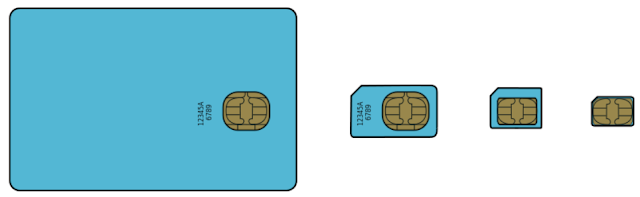 |
| GSM SIM card showing full-size SIM card (1FF), Mini SIM card (2FF), Micro SIM card (3FF) and Nano SIM card (4FF) |
full-size SIM
The first to appear was the full-size or 1FF (1st form factor), the size of a credit card (85.60 mm × 53.98 mm × 0.76 mm).
mini-SIM
The mini-SIM card has the same contact arrangement as the full-size
SIM card and is normally supplied within a full-size card carrier,
attached by a number of linking pieces. This arrangement (defined in ISO/IEC 7810 as ID-1/000)
allows such a card to be used in a device requiring a full-size card,
or in a device requiring a mini-SIM card after breaking the linking
pieces.
micro-SIM
The later 3FF card or micro-SIM cards have the same thickness and contact arrangements, but the length and width are further reduced as above.
The micro-SIM was developed by the European Telecommunications Standards Institute (ETSI) along with SCP, 3GPP (UTRAN/GERAN), 3GPP2 (CDMA2000), ARIB, GSM Association (GSMA SCaG and GSMNA), GlobalPlatform, Liberty Alliance, and the Open Mobile Alliance (OMA) for the purpose of fitting into devices otherwise too small for a mini-SIM card.
The form factor was mentioned in the December 1998 3GPP SMG9 UMTS Working Party, which is the standards-setting body for GSM SIM cards, and the form factor was agreed upon in late 2003.
The micro-SIM was created for backward compatibility. The major issue
with backward compatibility was the contact area of the chip. Retaining
the same contact area allows the micro-SIM to be compatible with the
prior, larger SIM readers through the use of plastic cutout surrounds.
The SIM was also designed to run at the same speed (5 MHz) as the prior
version. The same size and positions of pins resulted in numerous
"How-to" tutorials and YouTube video with detailed instructions how to
cut a mini-SIM card to micro-SIM size with a sharp knife or scissors.
These tutorials became very popular among first owners of iPad 3G after its release on April 30, 2010, and iPhone 4 on June 24, 2010.
The chairman of EP SCP, Dr. Klaus Vedder, said
- "With this decision, we can see that ETSI has responded to a market
need from ETSI customers, but additionally there is a strong desire not
to invalidate, overnight, the existing interface, nor reduce the
performance of the cards. EP SCP expect to finalise the technical
realisation for the third form factor at the next SCP plenary meeting,
scheduled for February 2004."
The iPhone 4S, a minor revision of iPhone 4, as well as the Samsung
Galaxy S3/S4, various Nokia Lumia handsets and the Nokia N9 used
micro-sim cards.
nano-SIM
In early 2012, the nano-SIM or 4FF (4th form factor) was
introduced, which measures 12.3 × 8.8 × 0.67 mm and reduces the previous
format to the contact area while maintaining the existing contact
arrangements. A small rim of isolating material is left around the contact area to
avoid short circuits with the socket. The 0.7 mm thickness of the
nano-SIM is about 15 percent less than its predecessor. 4FF can be put into adapters for use with devices taking 2FF or 3FF SIMs.
Nano-SIM cards were used by iPhone 5.
Embedded-SIM
SIMs for M2M applications are available in a surface mount SON-8 package which may be soldered directly onto a circuit board.
The surface mount format provides the same electrical interface as
the full size, 2FF and 3FF SIM cards, but is soldered to the circuit
board as part of the manufacturing process. In M2M
applications where there is no requirement to change the SIM card, this
avoids the requirement for a connector, improving reliability and
security.
Table of SIM cards

Developments
When GSM was already in use the specifications were further developed and enhanced with functionality like SMS, GPRS,
etc. These development steps are referred as releases by ETSI. Within
this development cycles the SIM specification was enhanced as well: new
voltage classes, formats and files were introduced.
In GSM-only times, the SIM consisted of the hardware and the software.
With the advent of UMTS this naming was split: the SIM was now an
application and hence only software. The hardware part was called UICC.
This split was necessary because UMTS introduced a new application, the
Universal Subscriber Identity Module (USIM). The USIM brought among
other things security improvements like the mutual authentication and
longer encryption keys and an improved address book.
"SIM cards" in developed countries are today usually UICCs
containing at least a SIM and a USIM application. This configuration is
necessary because older GSM only handsets are solely compatible with
the SIM [application] and some UMTS security enhancements do rely on the
USIM [application].
The equivalent of SIM on CDMA networks is the R-UIM (and the equivalent of USIM is CSIM).
A virtual SIM is a mobile phone number provided by a mobile network operator that does not require a SIM card to connect phone calls to a user's mobile phone.
SIM and carriers
The SIM card introduced a new and significant business opportunity for MVNOs - mobile virtual network operators
- who lease capacity from one of the network operators rather than
owning or operating a cellular telecoms network, and only provide a SIM
card to their customers. MVNOs first appeared in Denmark, Hong Kong,
Finland and the UK. Today they exist in over 50 countries, including most of Europe, United
States, Canada, Australia and parts of Asia, and account for
approximately 10% of all mobile phone subscribers around the world.
On some networks, the mobile phone is locked to its carrier SIM card,
meaning that the phone only works with SIM cards from the specific
carrier. This is more common in markets where mobile phones are heavily
subsidised by the carriers, and the business model depends on the
customer staying with the service provider for a minimum term (typically
12 or 24 months). SIM cards that are issued by providers with an
associated contract are called Sim only
deals. Common examples are the GSM networks in the United States,
Canada, Australia, the UK and Poland. Many businesses offer the ability
to remove the SIM lock from a phone, effectively making it possible to
then use the phone on any network by inserting a different SIM card.
Mostly, GSM and 3G mobile handsets can easily be unlocked and used on
any suitable network with any SIM card.
In countries where the phones are not subsidised, e.g., India
and Belgium, all phones are unlocked. Where the phone is not locked to
its SIM card, the users can easily switch networks by simply replacing
the SIM card of one network with that of another while using only one
phone. This is typical, for example, among users who may want to
optimise their carrier's traffic by different tariffs to different
friends on different networks, or when traveling internationally.
SIMware
SIMware is software held on or running on a SIM card.